


Note: I have added the latest Windows server versions in the title, but the below demonstration had been done with Windows 2008 R2 server version in VMware workstation. The key point is, the below steps are applicable for Windows 2012/2016 and even the latest Windows 2019 server cluster setup. Also, if you are a VirtualBox or Hyper-V on Windows 10 user, you can follow the same steps. Technically, you do not need many settings on the virtualization software to make this setup work. Mainly the VMs you are creating for this purpose should communicate among them to make the failover cluster work. They should be on the same virtual network.
You need to understand the requirements and configuration, then you can replicate the same setup either on VMware, VirtualBox or Hyper-V and with any version of Windows Server Operating Systems. You need to have a good physical computer to host these latest server virtual machines with minimal hardware requirements. Also, the latest FreeNAS version supports the iSCSI that can work with the Microsoft Failover cluster.
Here you can see how to setup Microsoft Windows 2008 R2 failover cluster in VMware Workstation. This article contains step by step method to install and setup Microsoft Windows 2008 R2 failover cluster with FreeNAS iSCSI disks in VMware workstation on a single physical computer.

Cluster disks are important to set up a failover cluster. The two (or more) servers should be able to see the storage which should run on a centralized place. In a production environment, it could be a SAN or NAS. In this example, we will use iSCSI disks with FreeNAS.
Windows Server failover clusters require SCSI-3 persistent reservation target disks as their cluster disks. Now the question is how to setup SCSI-3 persistent reservation cluster disks in VMware workstation or Oracle VirtualBox? Those steps are mentioned below.
Required Software
a) VMware workstation/VirtualBox/Hyper-V
b) Windows 2012/2016/2019 Operating System (or the latest Windows servers) as a virtual machine
c) FreeNAS as VM
Read more about Microsoft Windows 2008 R2 Failover cluster in the normal environment
Prerequisites setup
a) Install and configure Windows 2008 R2 (or 2012/2016/2019) Operating System in VMware Workstation (Minimum 3 servers are required. One will be the domain controller and other two will be cluster nodes). Do the same steps if you are doing it on VirtualBox.
b) Setup a domain (Active Directory) on a server and join other two servers with the domain. Use the domain administrator to log in to all servers. In this example, the domain name is sysprobs.net and cluster server names are vm-clus1 and vm-clus2. I assume you already have experience in setting up a domain controller in a virtual environment.
c) Install failover cluster feature on both Windows server VMs that we are going to set up a failover cluster in VMware workstation.
d) Add a 2nd network card to both cluster servers, it can be done in VMWare virtual machine settings. Give two separate IP addresses (not in the same range of other network cards), so both servers can communicate through this network also. This network will be the ‘heartbeat’ network for both servers. Make sure that all network cards/connections are identical in both servers. (in this example, heartbeat network named as ‘internal’ on both servers)
When you do the setup in VirtualBox, add second network adapter in VirtualBox settings for both cluster servers. This adapter will be configured for ‘Heartbeat network’.
Set the network type to ‘internal’ and assign separate IP address range than other networks. Make sure both nodes are communicating through this network also.
e) Create cluster disks in FreeNAS virtual machine. Read this guide about installing and configuring FreeNAS iSCSI disks in a virtual environment.
My setup is like below.
Qurom disk – 512MB,
Storage disk1- 2GB,
Storage disk 2- 2GB,
Storage disk 3 – 2GB,
and Backup disk 4GB)
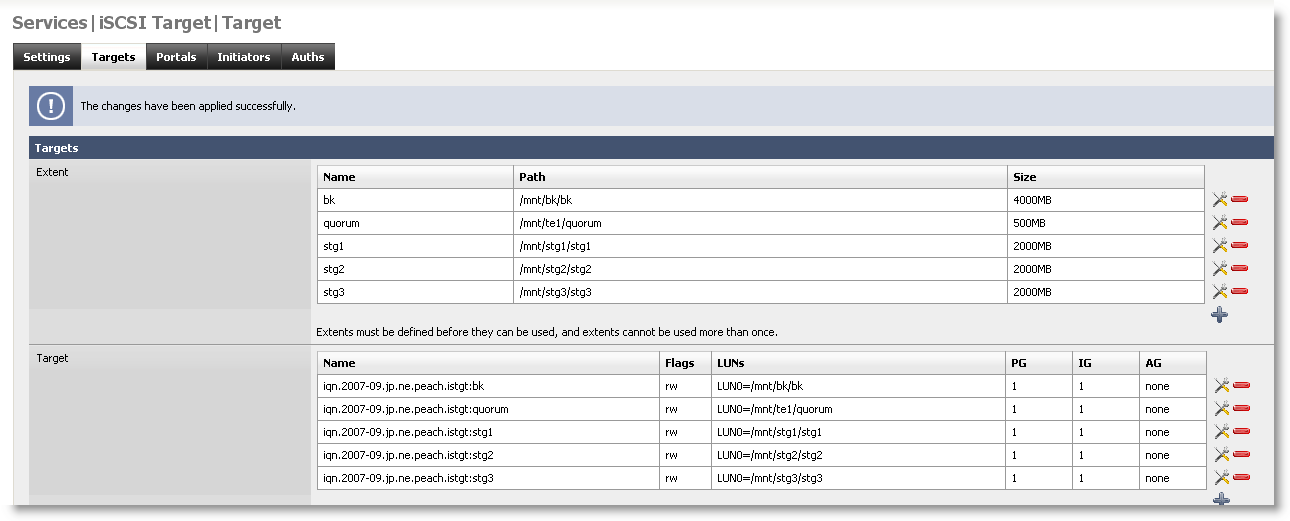
Configure Windows R2 Failover Cluster in VMware workstation/VirtualBox
1) In the first cluster server, Open iSCSI initiator under administrative tools. Click Yes, if it asks to start the iSCSI service.
2) Give FreeNAS VM IP address in Target and press Quick Connect. Let’s assume that the all 3 Windows servers (1 DC and 2 cluster nodes) and FreeNAS virtual machines can communicate via the network (It is one of the critical requirement).
It will detect your target disks. Press Done.
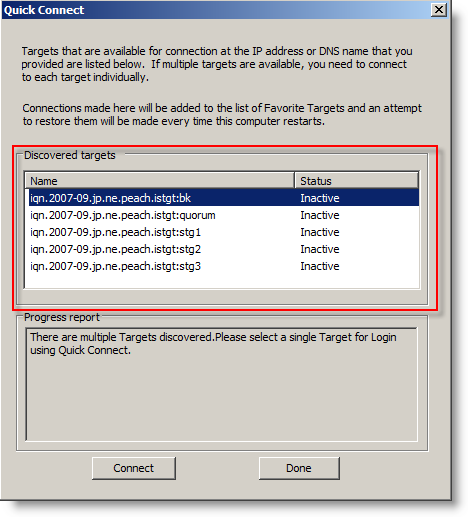
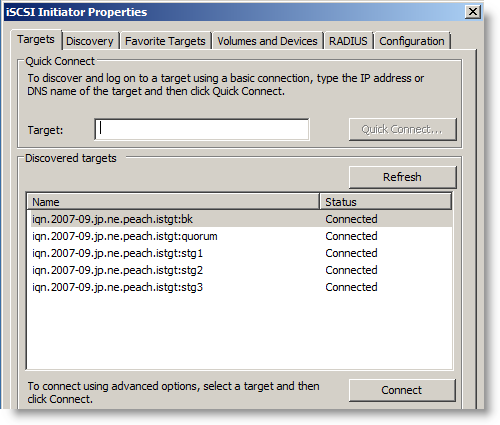
3) The disks will be shown as Inactive. Click on each target and press connect until all targets show as connected.
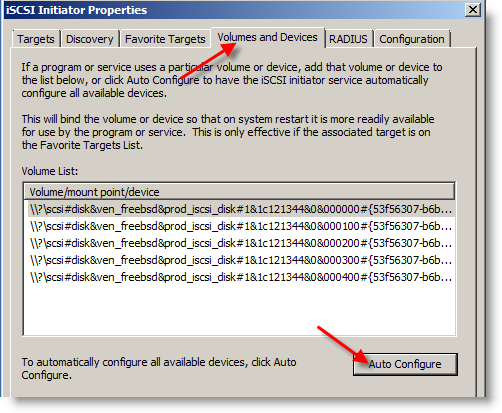
4) Go to Volumes and Devices tab, and press the Auto-Configure button. All targets will be displayed as disks under this tab.
5) All iSCSI disks will be listed under disk management. Right Click on each disk, make them online and Initialize.
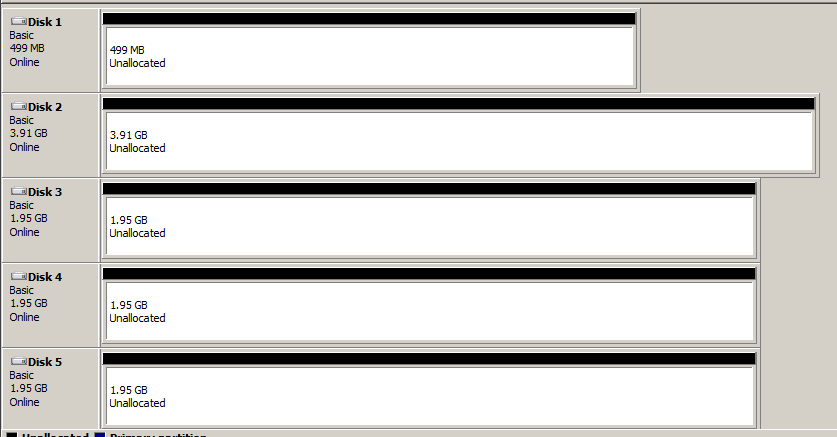
6) Create simple volumes by right-clicking and selecting on each unallocated space. Format the drives and give a name for each disk.
7) Once all disks are formatted and named successfully, right-click on each drive and make them offline again like below.
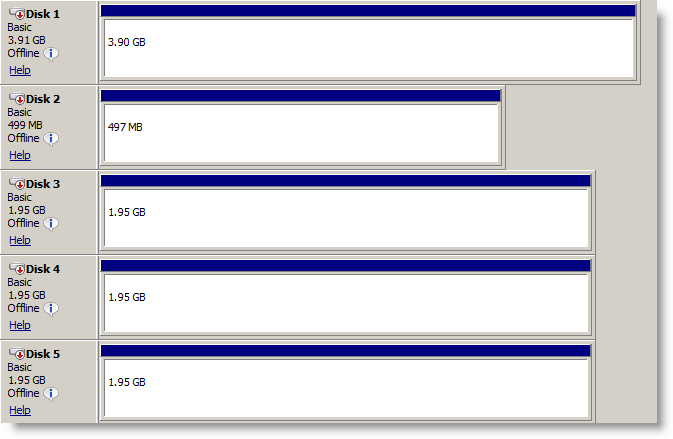
8) Just to remind you, we have done these steps in one server only. Now go to second cluster server. Start iSCSI services and detect all target disks as we did in the first server. But you do not need to format and give the name the disks in the second server. This step is to make the connectivity from the 2nd server to iSCSI disks.
9) Now, start failover cluster manager in features under the server manager. Before creating the cluster, better to validate cluster configuration, especially the tricky part of SCSI-3 persistent reservation iSCSI disks which we configured with FreeNAS. All Windows servers have a similar interface to do the setup, hence it will not confuse you here.
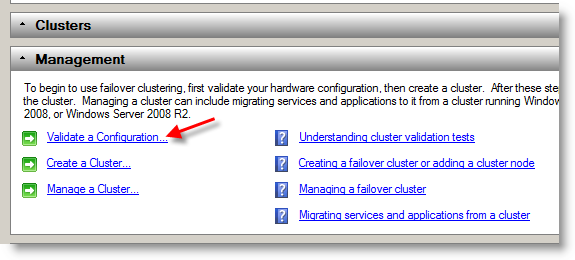
10) Click on Validate a configuration under management.
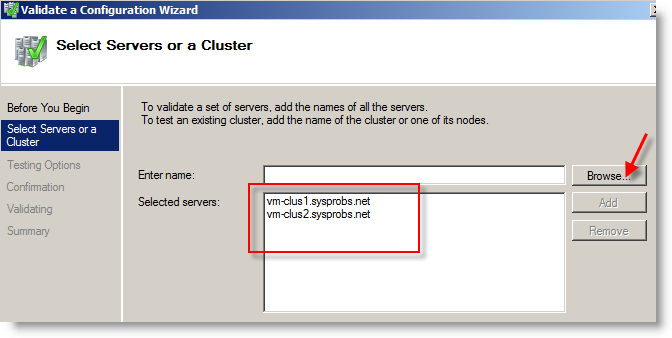
11) Click Next and browse the cluster servers from the directory or enter full name of servers.
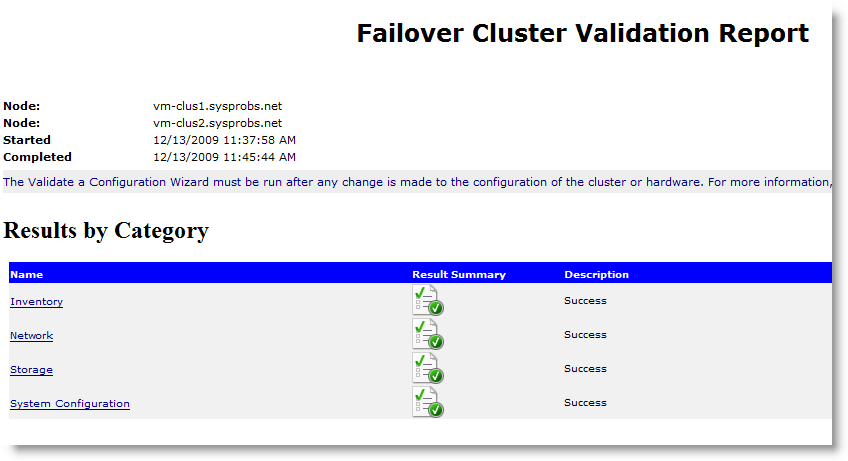
12) Run all tests and wait for the results. All main tests passed in my setup. We are ready to create Windows 2008 or R2 cluster in VMware workstation. The interface and steps almost remain the same on recent Windows server versions such as 2016 and 2019.

13) Final validation report will look like below.
Create the cluster now. Other steps are very easy. I don’t need to explain here since the cluster validation already succeeded.
14) I gave the cluster name as ‘ vm-cluster’ and separate IP address 192.5.2.250 for the cluster.
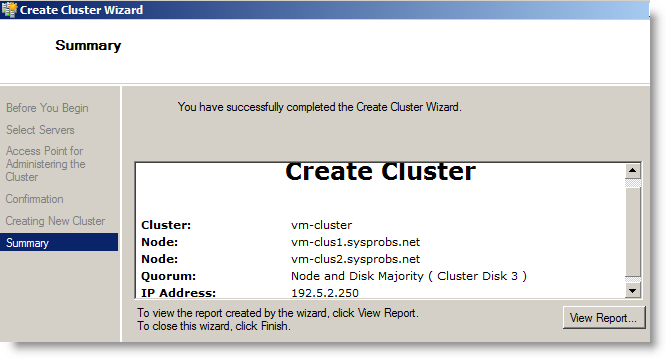
15) That’s it. We have successfully created a Windows 22019/2016/2012 R2 failover cluster in VMware workstation (or VirtualBox) using FreeNAS.
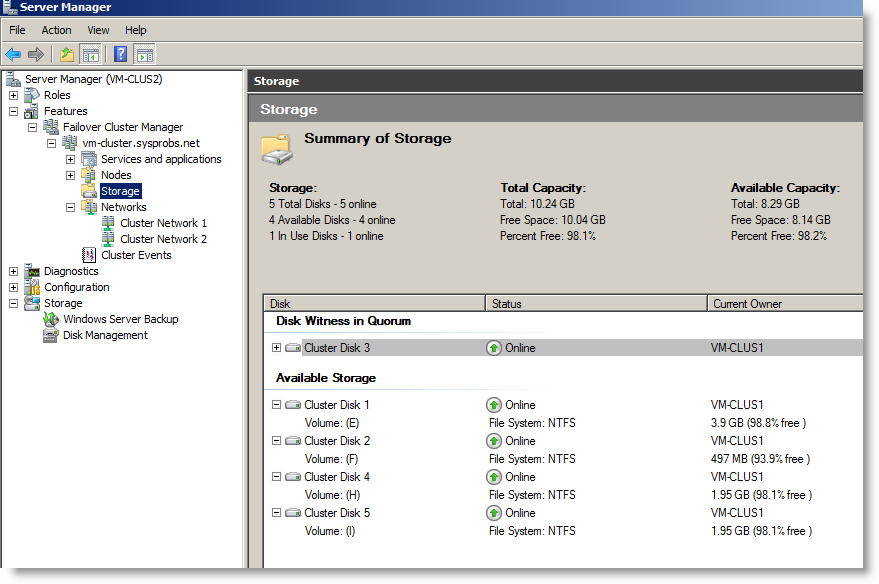
Unfortunately, it took one of my 2GB disks as a quorum disk. But no problem, we can change it later. That option is available in Windows cluster manager.
Now we have a working Windows failover cluster on VMware workstation which is running on our single physical computer. For testing purpose, you can install file-sharing or IIS server on the cluster and check the failover of the service. It will work well. It is the ideal way for testing and learning purpose if you are preparing for any Microsoft certifications.
Feel free to share your comments and problems with this. If you are satisfied with this post and blog, please share with others.

31 Comments
Hi Every one,
I’ve try to setup a similar conf on Workstation V8, I’ve an issue when validating IP conf :
Step followed :
– Create the two SRV.
– Add to AD ==> install the cluster service ==> add the netcard ==> Error Net conf not valide ???
First of all thanks for the great article. I was thinking I am almost there but I can’t get the iSCSI initiator cannot see the target. When I give the static IP address of FreeNAS VM to the iSCSI Initiator it gives the following message ” the name could not be resolved to an IP Address”
I have the following set up –
a) I am using VMWare Workstation 8
b) FreeNAS version – FreeNAS-8.0.3-RELEASE-p1-x64 (9591) installed on a flash drive
c) Two volumes on the FreeNAS (Quorum and DataStore)
d) Static IP
e) 3VMs that have Windows 2008 R2.One is a DC and the other two are joined to the same domain.
f) When I run the cluster validation report. Everthing passes except for Storage
g) Each of the Nodes have two NIC – Private(Heartbeat) and Public Network
How do I establish connection between Storage and the nodes? Currently I am using Bridged Connection (as my NAT setting) for FreeNAS.
Should the Storage VM also be part of the domain?
Any ping statements either from FreeNAS VM or the two nodes don’t seem to work.
Can you please suggest how to proceed further?
Thanks!!
Sugandha
Thanks for such an useful post it really help me in practicing otherwise i was about to forget.. once again thank-you very much and keep posting such nice article.